TRAINING & EDUCATIONAL RESOURCE
ASTM C443 · C497
Concrete Pipe Hydrostatic Testing
Scroll to explore the test process, watch the videos, and learn how concrete pipe stands up to pressure.
01 — WHAT IS HYDROSTATIC TESTING?
Pressure is just depth, measured another way.
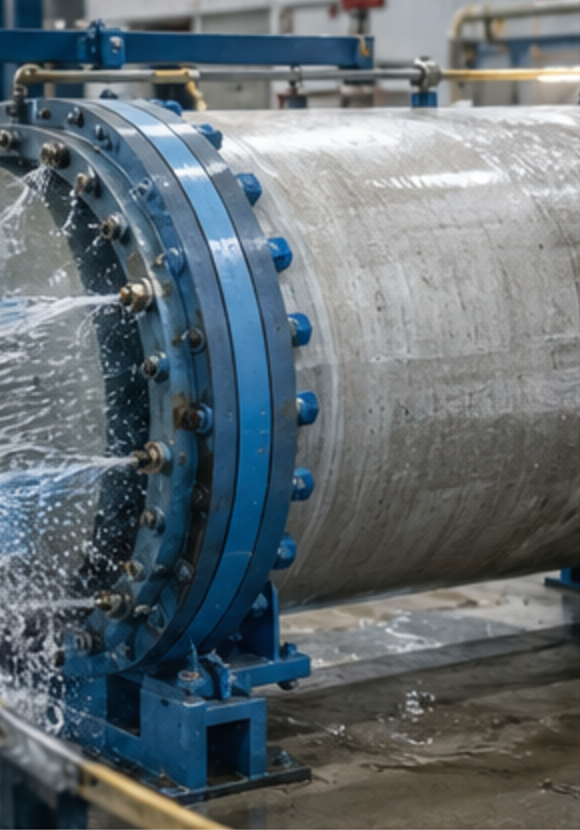
A hydrostatic test proves that water can't get through a concrete pipe joint under a set pressure. Two pipe sections are joined on their rubber gasket, sealed, filled with water and pressurized from the inside.
Every foot of groundwater adds about 0.43 psi. Testing at 13 psi recreates roughly 30 feet of water — then holds it while an inspector watches for any leak.
{{ s.v }}{{ s.u }}
{{ s.k }}
{{ t.n }}
FORMATION {{ t.n }} / 03 · {{ t.ref }}
{{ t.name }}
{{ t.desc }}
Inside + outside footage · Test {{ t.n }}
Camera inside the pipe · Test {{ t.n }}
03 — HISTORY
180 years of keeping water out.
{{ e.y }}
{{ e.t }}
{{ e.d }}
TCPA LIBRARY
More tests, more training.
Certified courses, webinars and Lunch & Learns — free, with PDH credits for engineers.
GET IN TOUCH
Contact us for more information
Thanks — the TCPA team will be in touch shortly.